
Saatva Latex Pillow shoppers usually aren’t looking for another list of specifications. They want to know whether this premium pillow will actually feel comfortable, provide the right amount of support, stay cool, and justify its $165+ price tag.
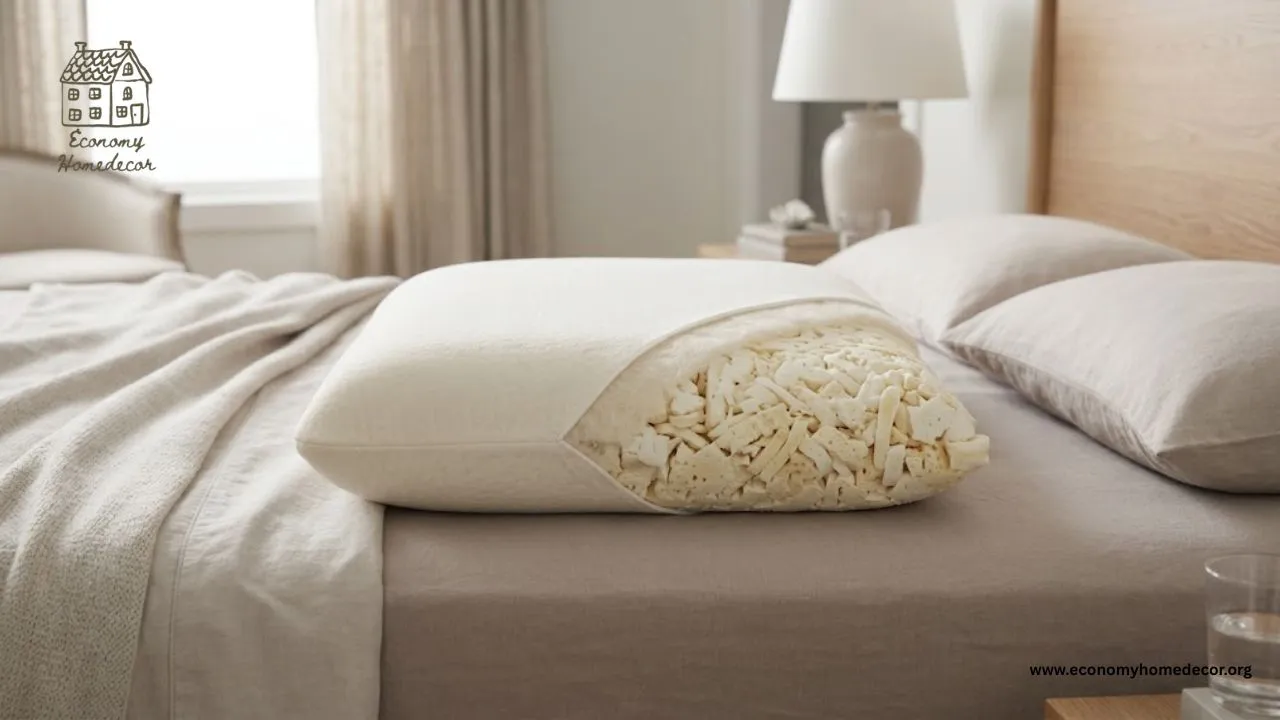
Saatva combines a shredded natural latex core with a softer microdenier fiber layer and an organic cotton cover. The result is quite different from sleeping directly on a dense solid-latex pillow. You get some of latex’s responsive support underneath, but the surface has more of that soft, hotel-pillow character.
That combination is also why the pillow is polarizing in a useful way. If you want a very moldable pillow that you can squeeze, fold, and reshape constantly, there are better choices. If you want something substantial that stays relatively structured, it makes much more sense.
Current Saatva pricing is $165 for Standard/Queen and $185 for King. That’s expensive for a pillow. So the construction has to earn its keep.
How the Saatva pillow is built
The current pillow uses three important elements:
- A shredded natural latex core
- A plush microdenier fiber layer
- An organic cotton cover
The latex is the structural part. It gives the pillow its responsiveness and resistance to flattening. The outer fiber layer changes the first impression. Instead of immediately feeling the dense, springy character people often associate with latex, your head encounters a softer surface.
That is a smart construction for people who like the idea of latex but don’t necessarily want a distinctly “latex” feel. Saatva says its natural latex undergoes washing to remove allergy-causing proteins and describes the material as breathable, durable, and resistant to dust mites and mildew.
Those claims should be understood as material characteristics, not a promise that the pillow will solve every allergy or sleep problem.
What does it actually feel like?
Think plush on top, supportive underneath. That is the simplest description. The pillow does not have the slow, dense response associated with traditional memory foam. Latex responds more quickly when you move your head. That matters if you dislike the sensation of getting stuck in a pillow.
At the same time, the outer fiber layer prevents the experience from feeling overly firm or rubbery. Independent reviewers repeatedly describe the pillow as comfortable, supportive, and relatively plush.
Tom’s Guide gave it very strong marks after testing, while TechRadar described it as a combination of squishiness and support. There is an important catch. The pillow is substantial. If your ideal pillow is thin, floppy, and easy to fold into a corner, this probably isn’t going to feel natural.
Standard Loft vs High Loft: the decision that matters most
Saatva currently offers two heights:
- Standard Loft: approximately 4to5 inches
- High Loft: approximately 6to7 inches
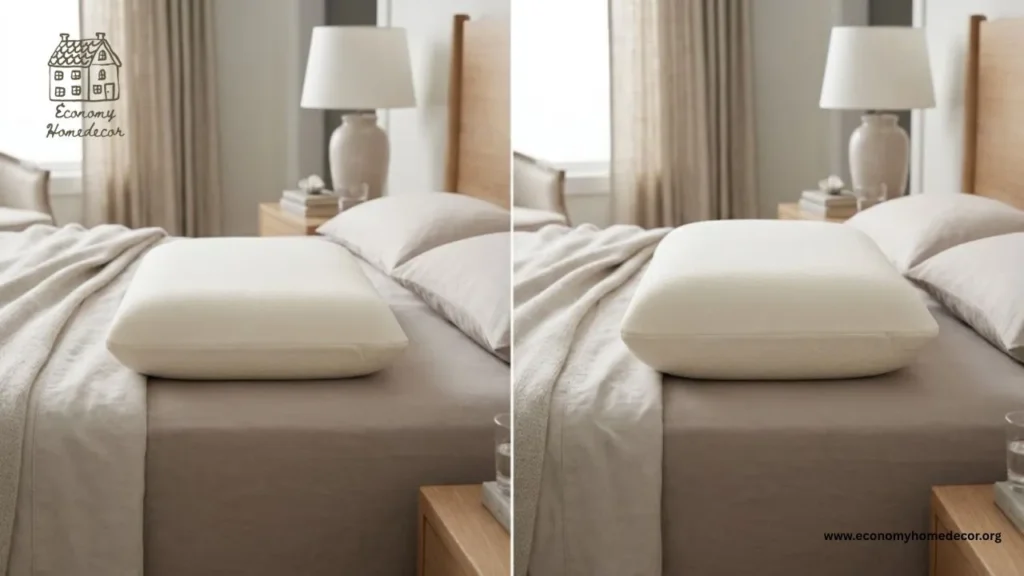
Saatva’s own guidance generally associates lower heights with stomach sleeping and higher heights with side sleeping, with back sleepers falling somewhere in between. But don’t treat those numbers as a universal prescription.
Your mattress changes the equation. A softer mattress lets your shoulder sink farther into the surface. A firmer mattress leaves your shoulder higher. Your body frame matters too. That means two side sleepers can need different pillow heights.
For side sleepers
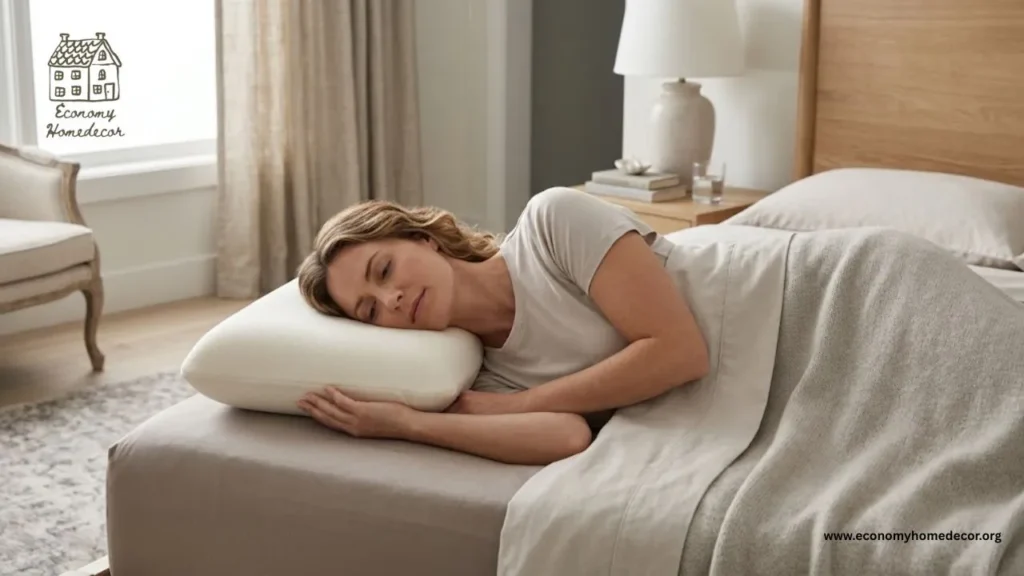
High Loft is the obvious starting point for many side sleepers because the greater height helps fill the space between the mattress and your head. Good Housekeeping’s testing specifically found the pillow popular among side sleepers and described the taller version as roughly 6 to 7 inches thick.
For back sleepers
Standard Loft is usually the safer starting point. You don’t want your head pushed noticeably forward. If your chin feels like it is being pushed toward your chest, the pillow may simply be too tall for you.
For stomach sleepers
This is where I would be cautious. A thick pillow can put your neck into an awkward position when you sleep face-down. Some reviewers have successfully used the High Loft in multiple positions.
But that does not make it universally appropriate for stomach sleepers. If you primarily sleep on your stomach, a thinner pillow is generally the more sensible direction.
Is the pillow actually adjustable?
This point needs clarification. Saatva offers two loft choices, but that is not the same thing as an infinitely adjustable pillow where you unzip the case and remove handfuls of filling until you get the exact height you want.
Good Housekeeping specifically notes that the fill is not adjustable. So if you have used an adjustable shredded-memory-foam pillow before, don’t assume the Saatva gives you the same level of customization.
The advantage is simplicity. You choose Standard or High and live with the construction. The disadvantage is obvious: if you’re extremely particular about loft, you have fewer ways to fine-tune it.
Does it sleep cool?
For a foam-based pillow, it performs well in this category. Latex generally has an advantage over dense memory foam because its structure allows more airflow. Saatva also describes natural latex as more breathable than synthetic foams.
Independent testing supports the general impression. Tom’s Guide called it suitable for hot sleepers, while Homes & Gardens tested it during a heat wave and reported that it did not noticeably retain excessive heat. Still, “cooling” deserves a reality check.
No pillow can guarantee that you will never feel warm. Your bedroom temperature, pillowcase fabric, bedding and personal heat sensitivity matter. The better claim is that Saatva’s construction is more breathable than many dense foam alternatives.
Is it good for neck and shoulder support?
Potentially, yes. But the pillow itself does not magically treat neck pain. Its value comes from maintaining an appropriate relationship between your head, neck, and sleeping surface. For a side sleeper, too little height can leave the head dropping toward the mattress.
Too much height can push the head upward. The right pillow is the one that keeps your neck relatively neutral for your particular body and mattress. That’s why simply copying another reviewer’s loft recommendation is risky.
Forbes Vetted highlights the balance between plushness and support and includes the pillow among options for people concerned about shoulder pain. That should be read as a comfort and positioning consideration, not medical treatment. If you have persistent or severe pain, a pillow review isn’t a substitute for professional evaluation.
What are the biggest downsides?
The price is the obvious one. At $165 for Standard/Queen and $185 for King, the pillow costs considerably more than many mainstream alternatives. The second issue is loft. High Loft is excellent if you need height. It can be excessive if you don’t.
The third is that this is not the most customizable pillow on the market. If you love experimenting with fill levels, an adjustable shredded-fill pillow may suit you better. There is also a weight and handling consideration. Some long-term users describe the pillow as heavier or more cumbersome than ordinary fiber pillows.
And while many people report excellent durability, online experiences aren’t perfectly uniform. Some users mention occasional stiffness, warmth, or the need to redistribute the filling. That’s exactly why a balanced review should not pretend the product is universally perfect.
How do you wash the Saatva Latex Pillow?
This is one area where following the manufacturer’s instructions matters. Saatva says to remove the shredded latex core before washing and not to wash the latex core itself. Its current help documentation recommends washing the pillow twice a year and replacing it after roughly three years.
The cover is designed to be machine washable. That distinction is important because “machine washable pillow” can be misleading if readers assume the latex core can simply go into the washer. It cannot. Keep the core dry and wash the appropriate removable components according to the manufacturer’s instructions.
How long should it last?
Saatva currently recommends replacement at around three years. That is a useful benchmark, although real lifespan depends on use, care, body weight, humidity, compression, and personal tolerance for changes in loft. The broader point is that latex is valued for resilience.
It generally rebounds better than materials that permanently compress under repeated loading. That does not mean it remains exactly like new forever.
What size should you buy?
The current dimensions are:
| Size | Dimensions |
| Standard/Queen | 28 × 18 inches |
| King | 34 × 18 inches |
Saatva notes that these pillows are slightly larger than standard pillow dimensions and recommends using its pillowcases. That last detail is easy to overlook. Before buying, check the dimensions of your existing pillowcase rather than assuming every “queen” pillow has identical measurements.
Is the price justified?
For some sleepers, yes. The case for paying more rests on several things happening at once:
- You like the plush feel of a down-alternative pillow.
- You want more structure underneath.
- You prefer latex to memory foam.
- You sleep on your side or back.
- You want a breathable construction.
- You value natural materials.
- You dislike pillows that lose their shape quickly.
If most of those statements sound like you, the premium becomes easier to justify. If you simply need a soft pillow and don’t care about latex, there is no reason to spend $165. That’s the uncomfortable truth about premium bedding: better materials don’t automatically make a product better for you.
Who should buy it?
The Saatva Latex Pillow makes the most sense for: Side sleepers, especially those who prefer substantial loft. Combination sleepers: particularly people who alternate between side and back positions. Back sleepers: especially those who dislike very soft pillows and need moderate structure.
Hot sleepers: people who prefer breathable materials to dense memory foam. Latex fans: especially those who like responsiveness without sleeping directly on a solid latex slab. People who like hotel-style pillows: the plush outer layer gives the pillow a softer first impression than many conventional latex designs.
Who should skip it?
You may be happier elsewhere if:
- You are primarily a stomach sleeper.
- You need a very low-profile pillow.
- You want to remove or add fill yourself.
- You prefer an extremely soft, collapsible pillow.
- You dislike heavier pillows.
- You are shopping on a tight budget.
- You specifically want the unmistakable bounce of solid latex.
- You want a pillow with extensive firmness customization.
There is no shame in skipping a highly rated pillow. A pillow can be excellent and still be wrong for your neck, shoulders, and sleeping style.
How does it compare with other pillow types?
Saatva Latex vs memory foam
Latex tends to feel more responsive. Memory foam generally contours more slowly and can create a deeper “sink.” If you dislike being held in one position, latex may be more appealing. If you love deep contouring, memory foam may win.
Saatva Latex vs adjustable shredded-fill pillows
The adjustable pillow wins on customization. The Saatva Latex pillow wins if you prefer a more finished, structured feel without constantly removing or adding filling.
Saatva Latex vs solid latex
Solid latex usually gives you a more direct latex sensation. The Saatva’s outer fiber layer softens that experience. That’s a major part of its appeal.
Frequently Asked Questions
Is the Saatva Latex Pillow good for side sleepers?
Yes. It is particularly well suited to many side sleepers because the High Loft version is approximately 6to7 inches tall, providing substantial height between the mattress and head. Independent testing has also identified it as a strong side-sleeper option
Is the Saatva Latex Pillow too firm?
It depends on what you are comparing it with. It has a plush surface but meaningful support underneath. Someone coming from a very soft fiber pillow may perceive it as firmer.
Does it smell like latex?
Individual experiences vary. Latex can have an initial material odor, but recent user discussions include people reporting no noticeable latex smell after receiving their pillow.
Can you remove filling from the Saatva Latex Pillow?
Not in the same way as a fully adjustable shredded-fill pillow. Saatva sells Standard and High Loft versions, while testing sources note that the fill itself is not user-adjustable.
Is the Saatva pillow cooling?
It is relatively breathable for a foam-based pillow. Natural latex is generally more airflow-friendly than dense memory foam, and independent reviewers have reported good temperature performance.
Can you wash the latex core?
No. Saatva specifically instructs users to remove the shredded latex core before washing and says not to wash the core
How often should the pillow be washed?
Saatva recommends washing the pillow twice a year and replacing it after around three years.
Does it work for stomach sleepers?
It can work for some people, but it is not the position I would prioritize for this pillow. Stomach sleepers generally benefit from less height, making Standard Loft the more sensible starting point.