
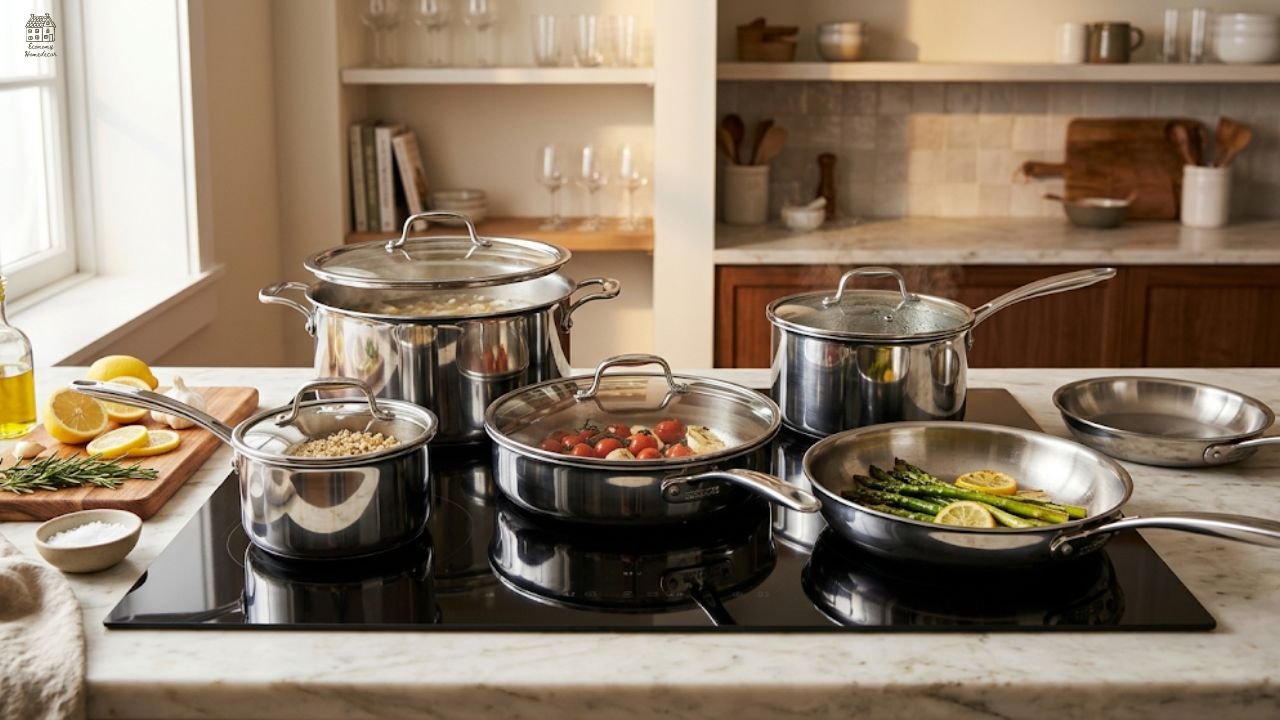
The best induction cookware does more than make a magnet stick to the bottom. It should sit flat, match the size of your cooking zone, spread concentrated induction heat without developing severe hot spots, and feel comfortable enough to use every day.
For most households, fully clad stainless steel is the most dependable foundation. It is durable, versatile, suitable for high-heat cooking, and does not rely on a coating that gradually loses its easy-release performance. Our leading complete-set choice is the All-Clad D3 10-Piece Set, while Tramontina Tri-Ply Clad offers much of the same practical flexibility at a lower price.
That does not mean every pan in your kitchen should be stainless steel. Eggs are easier in a good nonstick skillet. Slow braises suit enameled cast iron. Carbon steel works well for cooks willing to season and maintain it. The smartest induction kitchen is often a small collection of complementary pans rather than one oversized matching set.
The best induction cookware at a glance
| Category | Recommendation | Best suited to |
|---|---|---|
| Best overall set | All-Clad D3 10-Piece Stainless Steel Set | Long-term, all-purpose cooking |
| Best value set | Tramontina Tri-Ply Clad Stainless Steel | Everyday performance at a lower cost |
| Best curated starter set | Made In Stainless Starter Set | Buyers who want fewer, better pieces |
| Best ceramic set | Caraway Ceramic Cookware Set | Low-to-medium-heat, easy-clean cooking |
| Best nonstick skillet | Le Creuset Essential Ceramic Frying Pan | Eggs, pancakes and delicate fish |
| Best cast-iron skillet | Lodge Cast-Iron Skillet | Searing, roasting and heat retention |
| Best enameled cast iron | Staub or Le Creuset Dutch Oven | Braising, stews and oven cooking |
| Best carbon-steel option | OXO Carbon Steel Frying Pan | High-heat cooking with lighter handling |
These choices reflect the strongest areas of agreement among current testing-led publications. Serious Eats recommends All-Clad’s stainless set, a Le Creuset ceramic skillet, Lodge cast iron, OXO carbon steel and Made In stainless cookware. Good Housekeeping also places All-Clad D3 first and Tramontina in its value category. Food & Wine favours Made In’s starter set and Caraway’s ceramic collection, while The Guardian selects Caraway, Calphalon, Staub and Made In for different buyers.
How these recommendations were selected
This is a research-backed editorial comparison, not a claim that every product was personally tested for this article.
The shortlist was built by comparing recent recommendations from established cookware-testing publications, examining official construction and compatibility information, and reviewing the problems induction users raise repeatedly: uneven heating, warping, pan detection, buzzing, weight, coating life and wasted pieces in large sets.
A proper future hands-on update should test every shortlisted pan on the same induction surface using:
- Timed water-boiling tests
- Flour or thermal-camera heat maps
- Low-temperature sauce control
- Egg release
- Steak searing
- Handle-temperature measurement
- Base-flatness checks
- Noise readings
- Cleaning tests
- Repeated heating and cooling cycles
Until those tests are completed, it would be misleading to invent personal kitchen experience or label untested observations as laboratory results.
What makes cookware induction compatible?
An induction cooktop generates an electromagnetic field beneath its glass surface. The field interacts with magnetic material in the bottom of a pan, causing the cookware itself to heat.
Cast iron and carbon steel are naturally magnetic. Many stainless-steel pans also work, but not every stainless-steel alloy is sufficiently magnetic. Aluminum, copper and glass normally require a bonded magnetic layer before they can activate an induction burner. A magnet placed against the base is therefore a useful first compatibility check.
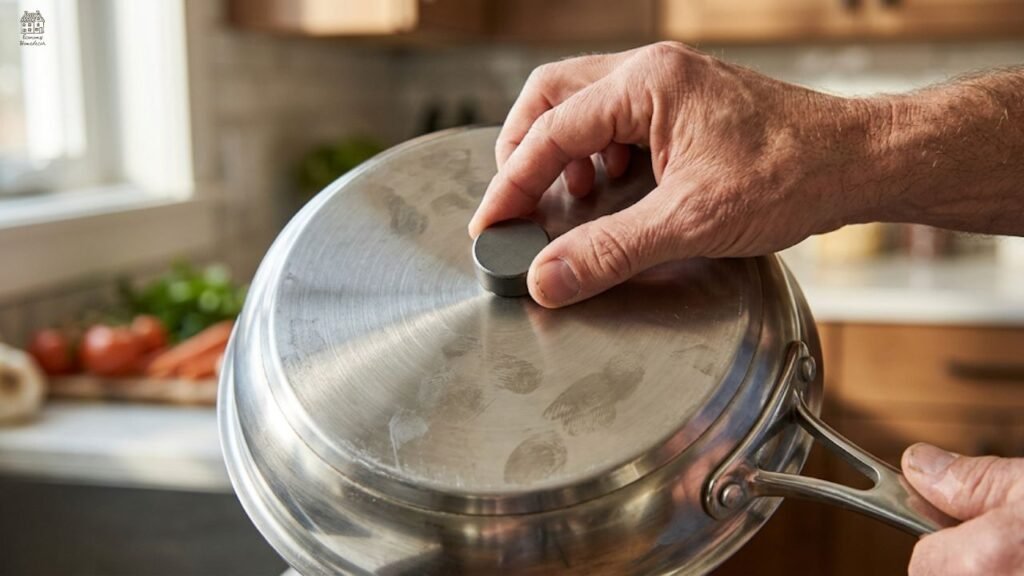
Look for a firm magnetic pull across a broad portion of the base. A weak attraction around one narrow ring may activate some cooktops but perform inconsistently on others.
The magnet test is not a complete performance test.
A magnetic pan may still:
- Be too small for the cooking zone to detect
- Have a warped or uneven base
- Concentrate heat in the centre
- Respond too aggressively at high power
- Produce noticeable humming or buzzing
- Rock on the glass surface
- Feel unbalanced when full
Research guidance on best induction cookware also emphasizes that the pan base should be similar in size to the cooking zone. A much smaller base may not be detected, while a much larger pan can heat unevenly because the active magnetic coupling is concentrated over a smaller area.
Best overall: All-Clad D3 Stainless Steel Cookware Set
All-Clad D3 is the safest premium recommendation for buyers who want a complete stainless-steel collection and expect to keep it for years.
The cookware uses tri-ply construction: an aluminum core is bonded between stainless-steel layers. The exterior is magnetic for induction compatibility, while the conductive core helps move heat beyond the concentrated area directly above the induction coil.
The standard 10-piece configuration includes two frying pans, a saucepan, a casserole or second saucepan, a sauté pan and a stockpot, with lids making up the remaining advertised pieces. All-Clad states that D3 cookware is compatible with induction and oven- and broiler-safe up to 600°F.
Where it performs best
- Browning meat
- Deglazing and making pan sauces
- Cooking acidic dishes
- Boiling pasta
- Sautéing vegetables
- Moving food from the cooktop to the oven
Reasons to hesitate
The set is expensive, and stainless steel requires technique. Eggs or delicate fish can stick when the pan is too cold, too hot or insufficiently oiled. Some cooks also dislike the traditional All-Clad handle shape.
Buy it when durability and broad cooking flexibility matter more than effortless food release.
Best value: Tramontina Tri-Ply Clad
Tramontina is the practical alternative for buyers who want fully clad stainless steel without moving into the highest price tier.
Its tri-ply construction combines an aluminum core with stainless-steel surfaces, while the magnetic exterior supports induction cooking. Tramontina offers several set configurations, so buyers should verify the exact lids, vessel sizes and oven-temperature limit attached to the model they are purchasing. Some glass-lid versions have lower oven limits than all-metal alternatives.
Both Good Housekeeping and The Spruce Eats feature Tramontina prominently, with the latter selecting a Tramontina Tri-Ply Clad set as its best overall option.
Where it performs best
- First serious stainless-steel purchase
- Family cooking
- Sauces, curries and soups
- Buyers who want even sidewall heating
- Everyday use without luxury-brand pricing
Reasons to hesitate
Individual versions differ, especially in lids and oven ratings. Do not assume every Tramontina tri-ply listing has identical specifications.
It is the better value when function matters more than prestige.
Best curated starter set: Made In Stainless
Many large cookware sets include pieces that look impressive in a product photograph but spend most of their lives in a cupboard. A smaller Made In collection is more attractive for buyers who want a few heavily used pieces rather than a full matching display.
Food & Wine’s current induction guide selects a six-piece Made In stainless starter set as its overall recommendation, while Business Insider also favours Made In as its leading induction set.
Made In states that its Stainless Clad cookware is induction compatible and oven-safe to 800°F. That high rating is useful for broiler and oven work, although most home cooking never approaches that limit.
Where it performs best
- Smaller kitchens
- Serious home cooks
- Buyers who prefer useful pieces over large set counts
- High-heat searing and oven finishing
- Cooks who appreciate a responsive stainless pan
Reasons to hesitate
It remains a premium purchase, and the smaller collection may need to be supplemented with an easy-release skillet or Dutch oven.
Best ceramic set: Caraway
Caraway is a strong choice for buyers who value easy cleanup, coordinated storage and a smooth ceramic-coated cooking surface.
The important detail is the vessel count. The well-known “12-piece” set contains four main pots and pans; lids and storage accessories account for the rest. Food & Wine specifically highlights this distinction, which should be visible before a buyer reaches the checkout button.
Caraway describes its cookware as compatible with gas, electric and induction cooktops. The body is aluminum, while a stainless-steel base plate provides induction compatibility. The company recommends low-to-medium heat and a small amount of oil to preserve the coating.
Where it performs best
- Eggs, pancakes and delicate foods
- Low-to-medium-heat cooking
- Cooks who prioritize easy cleaning
- Kitchens where coordinated storage matters
- Buyers who prefer a ceramic rather than conventional PTFE surface
Reasons to hesitate
Ceramic coating should be treated as a consumable surface, not an heirloom material. Its release can decline with repeated high heat, abrasion and dishwasher exposure. The pieces are also heavier than their visual styling may suggest.
Choose it for convenience, not because you expect the coating to behave like bare stainless steel for decades.
Best nonstick skillet: Le Creuset Essential Ceramic
A full nonstick cookware set is rarely necessary. A single quality nonstick frying pan usually covers eggs, crepes, pancakes and fragile fish, while stainless steel handles boiling, browning and acidic foods.
Serious Eats currently identifies the Le Creuset Essential ceramic frying pan as its leading induction-friendly nonstick choice.
This approach is financially sensible because coated skillets receive more wear than saucepans and stockpots. Replacing one frying pan after its release declines costs less than replacing an entire coated set.
Best use
Keep it for delicate foods. Avoid using it as the default pan for empty high-power preheating, hard searing or repeated broiler use unless the exact model’s instructions permit it.
Best cast-iron skillet: Lodge
A Lodge skillet is one of the least expensive ways to add serious heat retention to an induction kitchen. Cast iron is naturally magnetic and works well for searing, shallow frying, roasting, cornbread and dishes that move from cooktop to oven.
Serious Eats and chef-based recommendations from The Strategist both identify Lodge cast iron as an induction-friendly essential.
Where it performs best
- Steaks and burgers
- Shallow frying
- Oven roasting
- Foods that benefit from stored heat
- Buyers who want a long-lasting uncoated pan
Reasons to hesitate
Cast iron is heavy, slow to respond when heat needs to be reduced, and capable of scratching or marking a glass surface when dragged. It also needs drying and seasoning care.
Place it down gently and lift rather than slide it.
Best enameled cast iron: Staub or Le Creuset Dutch oven
Enameled cast iron combines induction compatibility with a nonreactive interior suited to tomato, wine, citrus and long braises.
The Guardian’s 2026 guide selects a Staub stackable set as its splurge recommendation, while professional cooks interviewed by The Strategist recommend Le Creuset Dutch ovens for stocks, braises and slow cooking.
A Dutch oven makes more sense than an entire enameled cast-iron set for most households. One medium vessel can handle stews, rice dishes, curry, bread, braised meat and deep frying.
The disadvantage is weight. Large enameled pots become difficult to manoeuvre when full.
Best carbon-steel option: OXO Carbon Steel Frying Pan
Carbon steel offers some of cast iron’s high-heat ability in a thinner, lighter format. It can develop a seasoned surface and works particularly well for searing, frying and dishes that benefit from fast temperature changes.
Serious Eats identifies the OXO Carbon Steel Frying Pan as a beginner-friendly induction option and recommends a Yosukata carbon-steel wok for induction cooking.
The main induction-specific concern is warping. Thin carbon steel can deform when a cold pan is exposed immediately to a small, intensely powered induction zone. Preheat gradually and avoid applying boost power to an empty pan.
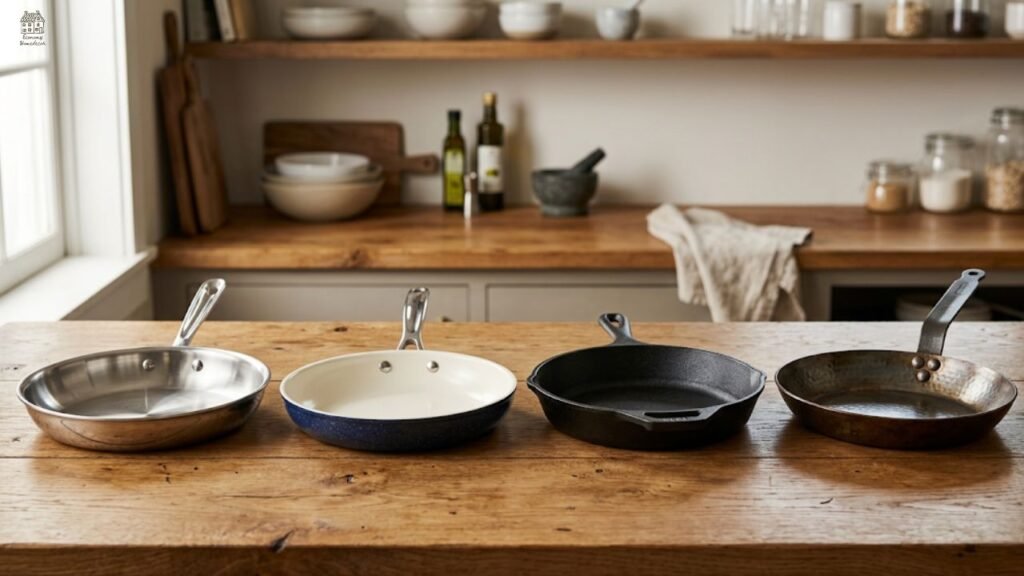
Stainless steel, ceramic, cast iron or carbon steel?
There is no universally superior material. The right answer depends on the food.
| Material | Best qualities | Main limitations | Best dishes |
|---|---|---|---|
| Fully clad stainless steel | Durable, versatile, nonreactive, good heat spread | Learning curve, food can stick | Sauces, curries, pasta, vegetables, meat |
| Ceramic-coated nonstick | Easy release and cleanup | Coating performance declines over time | Eggs, pancakes, delicate fish |
| Conventional nonstick | Excellent release | Must be protected from overheating and abrasion | Low-fat and delicate cooking |
| Cast iron | Strong heat retention, durable | Heavy, slow response, care required | Steak, frying, roasting |
| Enameled cast iron | Retention plus nonreactive interior | Heavy and expensive | Braises, stews, acidic dishes |
| Carbon steel | Lighter than cast iron, high-heat capable | Seasoning and warping risk | Stir-fry, searing, omelettes |
| Disc-bottom stainless | Often affordable and stable | Sidewalls may heat less evenly | Boiling, soups, stockpots |
Should you buy a cookware set?
A set is worthwhile when:
- You are replacing most of your cookware
- The set contains the sizes you already use
- You want matching lids and storage
- The bundled price is lower than buying the same pieces individually
- You are comfortable using the same material for most tasks
Buy individual pieces when:
- You already own compatible cookware
- You rarely use stockpots or small saucepans
- Storage is limited
- You want different materials for different dishes
- A set includes several near-duplicate sizes
- You only need to replace a worn skillet
A practical four-vessel induction kitchen can be built around:
- A 10- or 12-inch fully clad stainless-steel skillet
- A medium stainless-steel saucepan
- A stainless-steel sauté pan or rondeau
- An enameled Dutch oven
Add one nonstick skillet only when delicate foods are a regular part of your cooking.
How to match cookware to your induction cooktop
Before purchasing a set, read the cooktop manual and measure the flat magnetic base of the pans—not the wider diameter across the rim.
A pan can be labelled induction compatible yet fail on one cooking zone because the magnetic base is below that zone’s detection threshold. Users report cases where larger pans from a set work normally while a smaller magnetic saucepan is not detected.
Check five things:
1. Magnetic coverage
The magnet should attach firmly across the base rather than only to a narrow decorative ring.
2. Base diameter
Match the actual magnetic base reasonably closely to the cooking zone.
3. Flatness
Place the empty pan on a level surface. It should not rock or spin around a raised centre.
4. Weight
Very light pans are easier to handle, but extremely thin cookware can react harshly to concentrated induction heat.
5. Construction
Look for clear specifications: fully clad, bonded base, aluminum-core thickness, stainless grade, oven rating and coating type.
Common mistakes that damage induction cookware
Starting at maximum power
Induction can heat the base much faster than the upper walls. Gradual preheating reduces thermal stress, particularly in carbon steel, thinner stainless cookware and empty cast iron.
Using boost mode for everything
Boost is useful for water. It is unnecessary for preheating an empty frying pan.
Heating an empty nonstick pan
Coated pans should normally be used at low or medium settings and heated with food or cooking fat according to the manufacturer’s directions.
Placing a hot pan in cold water
Sudden temperature change can deform the base.
Sliding heavy cookware
Lift cast iron and large stainless-steel pots rather than dragging them across the glass.
Assuming “dishwasher safe” means “dishwasher ideal”
A dishwasher may not immediately destroy compatible cookware, but hand washing often protects finishes, edges and coatings for longer.
Why does induction cookware buzz?
A hum, buzz or faint vibration can result from the interaction between the cooktop’s electromagnetic field and the layers or components of a pan. The sound may change with power level, pan construction, food quantity and cooktop model.
Expensive cookware does not guarantee complete silence. Users report audible noise even with premium stainless-steel pans, while other pan-and-cooktop combinations remain relatively quiet.
A moderate sound at high power can be normal. Violent movement, popping, error messages or inconsistent detection deserves further investigation.
How to prevent stainless steel from sticking
Stainless steel is not defective because an egg sticks to it. The surface requires better heat and moisture control than a coated pan.
Use this sequence:
- Preheat gradually at medium or medium-low power.
- Add oil after the pan is warm.
- Let the oil spread before adding food.
- Dry meat or fish before it enters the pan.
- Do not force food to move immediately.
- Reduce power once browning begins.
Proteins often release more easily after a proper crust forms. For eggs and very delicate fish, using a dedicated nonstick skillet remains the simpler choice.
Final recommendation
Choose All-Clad D3 when you want a premium stainless-steel set with broad cooking flexibility. Choose Tramontina Tri-Ply Clad when value matters more than brand prestige. Choose a smaller Made In collection when you prefer fewer, carefully selected pieces.
Caraway is attractive for easy-release, low-to-medium-heat cooking, but its ceramic surface should be viewed as a convenience coating rather than a permanent one. Lodge cast iron remains one of the most useful affordable additions, while a Staub or Le Creuset Dutch oven is the better splurge for braising and slow cooking.
Most importantly, do not replace every pan merely because you bought an induction cooktop. Test what you already own, check the base dimensions, and buy only the pieces that solve a real cooking need.
Frequently Asked Questions
What cookware is best for an induction cooktop?
Fully clad stainless steel is the strongest all-purpose choice because it combines a magnetic exterior with a conductive core, allowing it to handle boiling, browning, sauces and oven cooking. A separate nonstick skillet and Dutch oven can cover tasks where stainless steel is less convenient.
Does all stainless steel work on induction?
No. Stainless steel must contain a magnetic exterior layer or induction-compatible base. Check the manufacturer’s label and perform a magnet test on the bottom.
Can aluminum cookware work on induction?
Bare aluminum normally cannot activate an induction burner. Aluminum cookware works when the manufacturer adds a magnetic stainless-steel plate or exterior layer.
Is cast iron safe on a glass induction cooktop?
Yes, but it should be lifted rather than dragged. Check the base for rough edges, baked-on debris or raised rings before placing it on the glass.
Why is my magnetic pan not detected?
The magnetic base may be too small for the selected zone, the base may not be flat, the magnetic layer may cover only a narrow area, or the cooktop may have a higher minimum detection diameter.
What cookware is least likely to warp?
Heavier, well-constructed fully clad stainless steel and thick cast iron are generally more resistant than very thin pans. Any material can be stressed by aggressive empty preheating or sudden cooling.
Is ceramic cookware good for induction?
It can be, provided it has a magnetic base. Ceramic-coated cookware is convenient for low-to-medium-heat cooking but should not be expected to retain its original release indefinitely.
Is a five-ply pan always better than tri-ply?
No. Layer count alone does not prove better heat distribution or durability. Layer material, thickness, geometry, weight and manufacturing quality matter more than the number printed on the box.
Do induction pans need to match the burner size?
They should be reasonably close. A base that is too small may not be detected, while a pan much larger than the active zone can heat unevenly.
Are induction cookware sets worth buying?
They are worthwhile when most of the included vessels match your real cooking habits. Count actual pots and pans separately from lids, racks, utensils and protectors before judging value.